Music
This page offers an overview of the works I have composed; you may also listen to audio files in MP3 format here. In recent years, it has become increasingly common for music to be composed using DAW software. However, I am not a DAW composer and still write my scores in the traditional manner. I do not enjoy working from a MIDI controller; rather, I prefer to work from an understanding of the score itself. The MP3 files therefore do not possess full digital-audio quality. This entails certain limitations in terms of sound — particularly in the lower registers, in (transitional) dynamics, and occasionally where two parts converge on the same note. Nevertheless, they offer a clear impression of how the music is intended to sound. You may listen to the music free of charge via this website. Alongside each work, you will also find links to the sheet music.
The Sick Rose
The Sick Rose is a musical exploration of vulnerability, longing, and concealed decay. The text, drawn from the poetry of William Blake, possesses an intense layered quality: beauty and corruption coexist, while innocence and experience are inextricably intertwined.
The work opens with ethereal, hushed tones in the lower voices, emerging as if from a distant and shadowed space. From this subdued beginning, the musical texture gradually unfolds. In this composition for SATB choir, contrast in sonority and space plays a central role. Dissonances arise — not merely as devices of tension, but as expressions of inner unrest and hidden disturbance.
The alternation between sparseness and intensity forms the heart of the piece. What begins as delicate and nearly intangible gradually expands into a field of sound in which the voices unite in a single breath. Yet beneath the surface, a sense of fragility remains — as though the rose, in all its beauty, already bears within it the knowledge of its own mortality.
The Sick Rose invites performers and listeners alike not merely to sing or to hear the notes, but to inhabit the tension between light and shadow. Within that tension, meaning emerges. Within vulnerability, connection is found.

Mitternacht - das Elfenlied
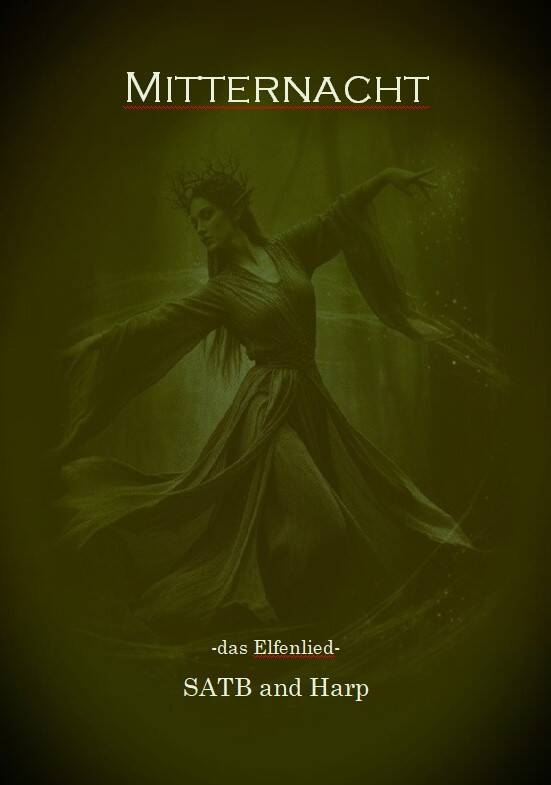
Mitternacht, das Elfenlied is written for SATB choir and harp, and finds its poetic origin in Das Elfenlied by Johann Wolfgang von Goethe. In this playful yet subtly layered poem, Goethe portrays a nocturnal scene in which an elf moves between dream and reality. What appears light and almost childlike at first glance reveals, upon closer reflection, a refined irony: perception and imagination intertwine, and the boundary between the real and the supernatural gently dissolves.
The musical foundation of this composition is formed by a four-bar theme introduced at the outset by the harp. This motif returns in varied guises and is further developed and transformed by the choir. Although the work is not a Chaconne — the historical form being rooted in triple meter — it shares the same underlying principle of continuous variation upon a recognizable foundation.
Both the harp and the bass voices function at various moments as the driving force of the piece. Their pulsating motion sustains a musical texture that is otherwise light, agile, and at times almost dance-like. Above this foundation, the choir unfolds a play of color, articulation, and character, bringing the nocturnal world vividly to life. The harp part is not written with a lot obbligato articulation to provide some freedom in musical interpretation.
L'atmosfera Mutevole
L’atmosfera mutevole is a composition for solo B-flat clarinet, written in E minor, and unfolds within a continually shifting landscape of colour, register, and character. The work opens in the low chalumeau register, where the instrument’s dark, veiled timbre evokes a mood of introspection. It also concludes in this same lower register, as though, after an inner journey, the music seeks once more the ground beneath its feet.
Between these two anchor points, a rich spectrum of expression emerges. The clarinet not only explores the warm depth of the chalumeau but repeatedly approaches the threshold of the altissimo register, where the sound becomes lighter, more ethereal, and almost fragile. These extremes of tessitura reflect the mutable atmosphere from which the work takes its name.
Articulation plays a central role in shaping this character. Buoyant staccato semiquavers generate movement and subtle restlessness, while brief legato phrases in crotchets create moments of breath and reflection. Expressive indications such as dolce, lamentevole, and misterioso delineate distinct emotional layers within the piece: tenderness, lament, and mystery alternate and at times merge seamlessly into one another.
Thus, the work becomes more than a melodic line for a solo instrument; it is an evolving inner landscape, painted through shifting timbre and gesture — an atmosphere in perpetual transformation.

Beautiful Weather
– walk and dance in the park-
Beautiful Weather is a musical impression of a day in the park, in which light, movement, and human encounters gently unfold. The work for violin and piano opens with joyful broken chords in the violin, preferably making use of open strings. Their clear resonance lends the music a natural radiance, as though the first rays of sunlight were greeting the morning. Sadly enough the Midi doesn't play the broken chords very well.
After this sparkling introduction, an unhurried walk begins to emerge. The melodic lines move lightly and freely, like footsteps along a winding path. The piano supports and colours the texture, while violin and piano together evoke a sense of openness and fresh air.
At times more animated moments arise: a (wild) round dance in which rhythm and energy take the lead. Here the music may be exuberant, almost unrestrained, like children at play or figures dancing upon the grass. In contrast, there are passages of sweet, warm tone that depict lovers strolling in their own world, detached from the bustle around them.
A particularly delicate moment appears in the theme accompanied by harp-like figuration in the piano. The gentle arpeggios create a musical image of tender spring flowers moving in soft light — fragile, yet full of promise.
In the final bars the atmosphere subtly changes. The light grows warmer, the lines become still. The sun slowly descends behind the horizon. The listener anticipates one final note — a concluding affirmation — yet it does not sound. The day has ended; the sun has already set. In that silence, the image is allowed to linger.
