Choir music Annemieke Lustenhouwer
This page offers an overview of the choir works I have composed; you may also listen to audio files in MP3 format here. I am not a DAW composer and still write my scores in the traditional manner. Nevertheless, the MP3's offer a clear impression of how the music is intended to sound. You may listen to the music free of charge via this website. Alongside each work, you will also find links to the sheet music.
The Sick Rose
The Sick Rose is a musical exploration of vulnerability, longing, and concealed decay. The text, drawn from the poetry of William Blake, possesses an intense layered quality: beauty and corruption coexist, while innocence and experience are inextricably intertwined.
The work opens with ethereal, hushed tones in the lower voices, emerging as if from a distant and shadowed space. From this subdued beginning, the musical texture gradually unfolds. In this composition for SATB choir, contrast in sonority and space plays a central role. Dissonances arise — not merely as devices of tension, but as expressions of inner unrest and hidden disturbance.
The alternation between sparseness and intensity forms the heart of the piece. What begins as delicate and nearly intangible gradually expands into a field of sound in which the voices unite in a single breath. Yet beneath the surface, a sense of fragility remains — as though the rose, in all its beauty, already bears within it the knowledge of its own mortality.
The Sick Rose invites performers and listeners alike not merely to sing or to hear the notes, but to inhabit the tension between light and shadow. Within that tension, meaning emerges. Within vulnerability, connection is found.

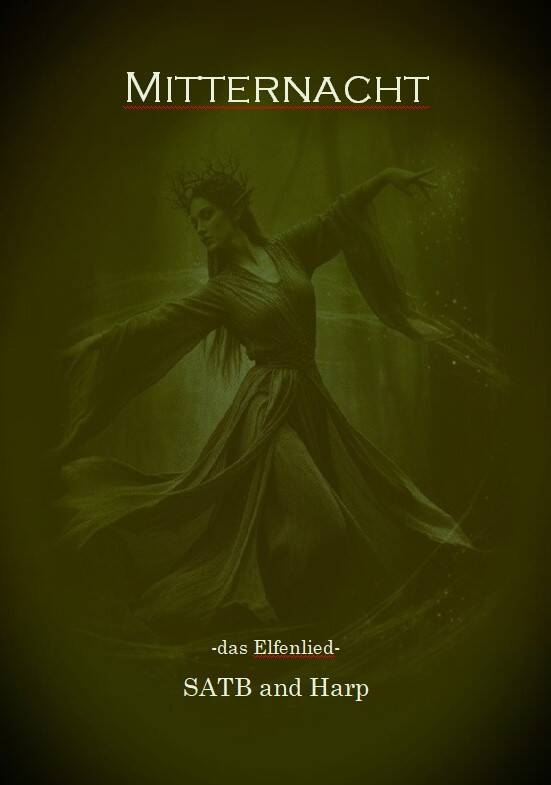
Mitternacht - das Elfenlied
Mitternacht, das Elfenlied is written for SATB choir and harp, and finds its poetic origin in Das Elfenlied by Johann Wolfgang von Goethe. In this playful yet subtly layered poem, Goethe portrays a nocturnal scene in which an elf moves between dream and reality. What appears light and almost childlike at first glance reveals, upon closer reflection, a refined irony: perception and imagination intertwine, and the boundary between the real and the supernatural gently dissolves.
The musical foundation of this composition is formed by a four-bar theme introduced at the outset by the harp. This motif returns in varied guises and is further developed and transformed by the choir. Although the work is not a Chaconne — the historical form being rooted in triple meter — it shares the same underlying principle of continuous variation upon a recognizable foundation.
Both the harp and the bass voices function at various moments as the driving force of the piece. Their pulsating motion sustains a musical texture that is otherwise light, agile, and at times almost dance-like. Above this foundation, the choir unfolds a play of color, articulation, and character, bringing the nocturnal world vividly to life. The harp part is not written with a lot obbligato articulation to provide some freedom in musical interpretation.
Speak of the North!
Speak of the North! A Lonely Moor is a work for SATB a cappella choir set to a text by Charlotte Brontë (1816–1855), the English novelist and poet best known for her novel Jane Eyre. Alongside her prose, Brontë wrote poetry that often reflects the stark beauty, solitude, and emotional intensity of the northern English moorlands that surrounded her home in Yorkshire. The poem used in this piece evokes precisely such a landscape: vast, windswept, and deeply contemplative.
The composition seeks to capture the atmosphere of this lonely moor. Each stanza begins with two strong unison notes, sung forte by the choir. These opening gestures are intended to draw the listener immediately into the scene, as if the landscape itself suddenly appears before the eyes — wide, open, and uncompromising.
In the second part of each stanza, the basses introduce a moving motif that suggests a gentle wave-like motion. This undulating line symbolizes the natural movement within the stillness of the moor: the wind passing over the land, the distant rolling of the terrain, or the quiet pulse of the landscape itself.
The work is set in a minor, a key chosen to reflect the melancholic and introspective character of the poem and its imagery. Through this tonal language and the interplay of voices, the music aims to convey both the solitude and the quiet, enduring beauty of the northern moorlands that inspired Brontë’s words.

Late in Spring
Late in Spring is an a capella choral work that reflects on the quiet, reflective atmosphere of a garden in the final weeks of spring. At this moment in the season, beauty and melancholy often coexist: the fullness of growth is present, yet there is already a gentle awareness that the season will soon pass.
The piece opens with a call from the basses, inviting the listener — as if opening a gate — to step into the garden and observe the scene. This musical gesture serves as a quiet summons to contemplation, setting the tone for what follows. In the second stanza the upper voices take up the narrative, describing a solitary rose standing beside a wall. Their lines bring another color to the music while the lower voices join.
Written in a flowing 3/4 metre, the music maintains a gentle sense of motion throughout, suggesting the subtle movement of the garden: a soft breeze, the slow passage of time, and the delicate life of late spring. In this way the work seeks to capture a moment that is at once serene, wistful, and quietly alive.
The text and composition are both written by Annemieke Lustenhouwer. The last page of the score contains the full text.

Thy Gift, thy Tables
This composition for SATB choir and piano is based on Sonnet 122 by William Shakespeare. Shakespeare reflects upon the relationship between memory and the tangible means by which memory is preserved. The poet refers to a notebook once given to him in order to record thoughts and feelings, yet he ultimately suggests that true remembrance does not depend upon written words. What truly matters lives within the heart and the mind itself.
The music is written in A major and opens with a brief piano prelude that establishes the atmosphere and tempo of the piece. When the choir enters, it does so in unison on the dominant, followed immediately by a tonic chord in which the voices open into harmony. This moment marks, as it were, the beginning of the shared musical narration.
After this opening, the musical texture briefly becomes more intimate. The soprano and alto voices are heard together for several measures, after which the tenor and bass join them once more, allowing the choral sound to deepen. This alternation between smaller and fuller textures mirrors the reflective character of the text.
The character of the work is con moto, set in a flowing triple metre. The movement remains light and continuous, as though the poet’s thoughts unfold in a calm yet steady current. Within this motion, the choir carries the text with clarity, while the piano provides in a rhythmic way a foundation upon which Shakespeare’s words are allowed to resonate.
